
| Product Name | PIGMENT YELLOW 139 |
| Synonyms | C.I.Pigment Yellow 139; C.I.PY139; PY139; P.Y.139 |
| C.I. | 56298 |
| CAS NO. | 36888-99-0 |
| EINECS | 253-256-2 |
| Molecular Weight | 367.27 |
| Molecular Formula | C16H9N5O6 |
| Density | 1.696g/cm3 |
| Color | Yellow powder |

| Product Name | PIGMENT YELLOW 139 |
| Synonyms | C.I.Pigment Yellow 139; C.I.PY139; PY139; P.Y.139 |
| C.I. | 56298 |
| CAS NO. | 36888-99-0 |
| EINECS | 253-256-2 |
| Molecular Weight | 367.27 |
| Molecular Formula | C16H9N5O6 |
| Density | 1.696g/cm3 |
| Color | Yellow powder |
| Light Fastness | 6 |
| Heat Resistance(℃) | 200 |
| Water Resistance | 4 |
| Oil Resistance | 5 |
| Acid Resistance | 5 |
| Alkali Resistance | 5 |
| Alcohol Resistance | 4 |
We have various pigment grades and properties to meet different customers’ needs, please specify your application and requirements so that we can recommend accordingly.
Pigment Yellow 139 is suitable for paint, plastic and printing ink. The different particle size distribution shows different color characteristics. The hue angle can be 78, 71, 66 degrees depending on the average particle size; the non-transparent type presents stronger red light ( Paliotol Yellow 1970 has a specific surface area of 22m2/g and L2140HD has a specific surface area of 25m2/g). Increasing the concentration does not affect gloss and has excellent light and weather fastness; it can be used with inorganic pigments to replace chrome yellow. It is suitable for high-end coatings (auto repair paint), with light resistance of 7-8 (1/3SD) in alkyd melamine resin; resistance to bleeding in soft PVC, and temperature resistance of 250 in HDPE (1/3SD) ℃, suitable for polypropylene.
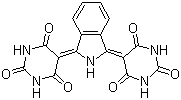
Pigment yellow 139 is an organic compound that is used as a yellow-orange pigment. It is classified as a derivative of isoindoline. This yellow-orange solid is virtually insoluble in most solvents. The species is prepared by addition of ammonia to o-phthalonitrile to give the diiminoisoindoline, which in turn condenses with barbituric acid.
IUPAC Name: 5-[3-(6-hydroxy-2,4-dioxo-1H-pyrimidin-5-yl)isoindol-1-ylidene]-1,3-diazinane-2,4,6-trione
InChI: InChI=1S/C16H9N5O6/c22-11-7(12(23)19-15(26)18-11)9-5-3-1-2-4-6(5)10(17-9)8-13(24)20-16(27)21-14(8)25/h1-4H,(H2,18,19,22,23,26)(H3,20,21,24,25,27)
InChIKey: VXQNQGCWKZPKET-UHFFFAOYSA-N
Canonical SMILES: C1=CC=C2C(=C1)C(=C3C(=O)NC(=O)NC3=O)N=C2C4=C(NC(=O)NC4=O)O
| Property Name | Property Value |
| Molecular Weight | 367.27 |
| XLogP3-AA | -0.9 |
| Hydrogen Bond Donor Count | 5 |
| Hydrogen Bond Acceptor Count | 7 |
| Rotatable Bond Count | 1 |
| Exact Mass | 367.055283 |
| Monoisotopic Mass | 367.055283 |
| Topological Polar Surface Area | 166 Ų |
| Heavy Atom Count | 27 |
| Formal Charge | 0 |
| Complexity | 892 |
| Isotope Atom Count | 0 |
| Defined Atom Stereocenter Count | 0 |
| Undefined Atom Stereocenter Count | 0 |
| Defined Bond Stereocenter Count | 0 |
| Undefined Bond Stereocenter Count | 0 |
| Covalently-Bonded Unit Count | 1 |
| Compound Is Canonicalized | Yes |
[From:PubChem]


